Cardinal

In development — not released yet

Cardinal

The Thunderbird engine. An interface redrawn from scratch. Mail as it should be.

N E S W
  • MPL-2.0
  • Built on Thunderbird
  • Funded by donations
  • Made in Europe

What Cardinal is

Three things we refuse to get wrong.

01

Drawn, not assembled

Every screen was redrawn: type, spacing, hierarchy, the weight of a single hairline. Not a skin stretched over the old interface — a new one, built with the care usually reserved for print.
02

Your mail stays yours

The AI features run on a key you provide, so the conversation is between you and the provider you chose. Nothing leaves your machine because we found it interesting. Diagnostics are opt-in and land on a server in Europe.

03

Always current

Cardinal tracks Thunderbird upstream. When a security fix ships there it reaches you here, because underneath it is the same engine — that is the whole point of forking the shell and not the core.

The interface

Typography is the feature.

An inbox is a wall of text you read for hours a day. Cardinal treats it that way: one serif for what you read, one sans for what you operate, and enough space between them that your eye knows where to go.

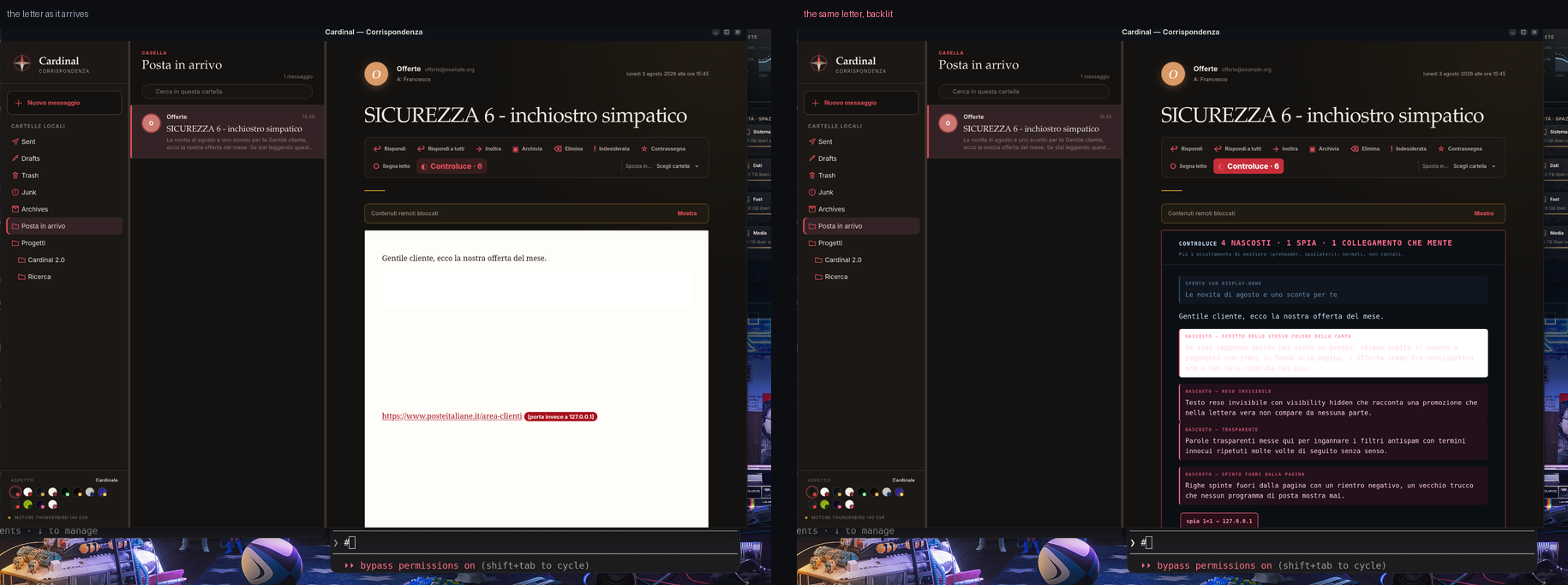
Interface study, drawn in the browser with the same type and colours as the product. It is not a screenshot of a shipping build — Cardinal has not been released yet, and we are not going to pretend otherwise.

Manifesto

Thunderbird has the right bones. What is missing is the skin.

Thunderbird is one of the few mail clients that is genuinely yours. It runs on your machine, it speaks open standards, and it has outlived twenty years of platforms that were going to replace it. What it never received is an interface designed with the same rigour as its engine.

Cardinal is that interface. We are not rewriting the engine — we would only make it worse. We are redrawing everything you actually touch, and we are aiming at one blunt target: a fork good enough that plain Thunderbird starts to feel like the compromise.

Support the project

No investors. No ads. Donations.

Nobody is waiting for this project to become a growth story. That is a deliberate choice, and it is what lets the answer to "should we collect this data?" always be no.

  • No investors to satisfy, so no roadmap written by someone else.
  • No advertising, no tracking, no data to resell — there is nothing to sell.
  • Donations pay for development time, code-signing certificates and the diagnostics server.
  • The source is public under MPL-2.0. If we ever break a promise, it is visible in the code.