Drawn, not assembled
Every screen was redrawn: type, spacing, hierarchy, the weight of a single hairline. Not a skin stretched over the old interface — a new one, built with the care usually reserved for print.
In development — not released yet
The Thunderbird engine. An interface redrawn from scratch. Mail as it should be.
What Cardinal is
Every screen was redrawn: type, spacing, hierarchy, the weight of a single hairline. Not a skin stretched over the old interface — a new one, built with the care usually reserved for print.
Cardinal looks first for a model running on your own computer: when it finds one, your mail never leaves the machine. A key is optional and always yours — we provide none. Either way, every action shows a receipt: exactly what left this computer, and what it said. Diagnostics are opt-in and land on a server in Europe.
Cardinal tracks Thunderbird upstream. When a security fix ships there it reaches you here, because underneath it is the same engine — that is the whole point of forking the shell and not the core.
The interface
An inbox is a wall of text you read for hours a day. Cardinal treats it that way: one serif for what you read, one sans for what you operate, and enough space between them that your eye knows where to go.
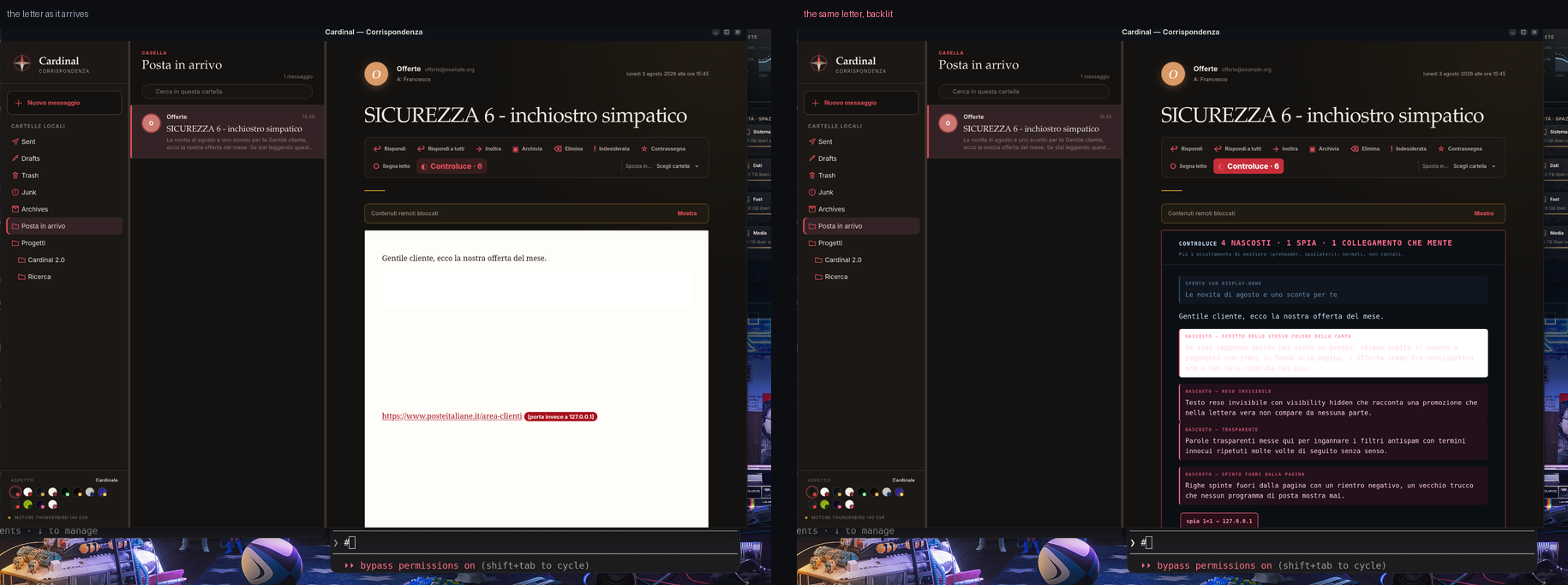
Interface study, drawn in the browser with the same type and colours as the product. It is not a screenshot of a shipping build — Cardinal has not been released yet, and we are not going to pretend otherwise.
Backlit
The one the sender drew for you, and the one that is actually there. Hold a key and Cardinal shows you the second: text hidden white on white, tracking pixels, links whose text says one thing and whose address says another, code the message wanted to run. Each marked exactly where it was.
Almost all honest commercial mail hides some text as a matter of craft: the preheader used for previews, spacers. That stays grey and is not counted. Only deception lights up. When in doubt, grey.
In the backlit view there is not a single remote reference: images become silhouettes labelled with the domain they would have called. By construction it cannot load anything — safer than normal reading, not less.
Not for lack of skill: a service that lives on commercial mail cannot systematically light up the manipulative layer of commercial mail. We have nothing to sell you, so we can.
Manifesto
Thunderbird has the right bones. What is missing is the skin.
Thunderbird is one of the few mail clients that is genuinely yours. It runs on your machine, it speaks open standards, and it has outlived twenty years of platforms that were going to replace it. What it never received is an interface designed with the same rigour as its engine.
Cardinal is that interface. We are not rewriting the engine — we would only make it worse. We are redrawing everything you actually touch, and we are aiming at one blunt target: a fork good enough that plain Thunderbird starts to feel like the compromise.
Support the project
Nobody is waiting for this project to become a growth story. That is a deliberate choice, and it is what lets the answer to "should we collect this data?" always be no.